Visitors

Wednesday, January 4, 2017

PAU 2015-2015 JUNE A DO ALIENS REALLY EXIST?

4. A) HADN´T BELIEVED / TO
CONDITIONAL SENTENCE TYPE 3 / 
VERB + PRESPOSITION
B) WHOSE / BY
RELATIVE PRONOUN (POSSESSION) / PASSIVE PREPOSITION BEFORE COMPLEMENT
C) MUCH / WAS GIVEN
UNCOUNTABLE HOW MUCH / PASSIVE VOICE, PAST SIMPLE
D) OF / THOUGHT

Next test: 2014-2015 B
Genetic Fingerprinting
Due to: January, 11th


Wednesday, December 28, 2016

PAU September 2014 1015 B Use and Abuse of Technology


4. a) which / in
b) wouldn´t communicate / didn´t exist (Conditional sentences)
c) getting / had been using
 (Gerund after preposition / Past perfect Continuous)
d) The report souldn´t have been sent
(Reported Speech:. shouldn´t doesn´t change) 

NEXT TEST:
JUNE 2014 2015 A 
DO ALIENS REALLY EXIST ?
DUE TO: Jan., 4th, 2017

Happy New Year!!

Tuesday, December 20, 2016

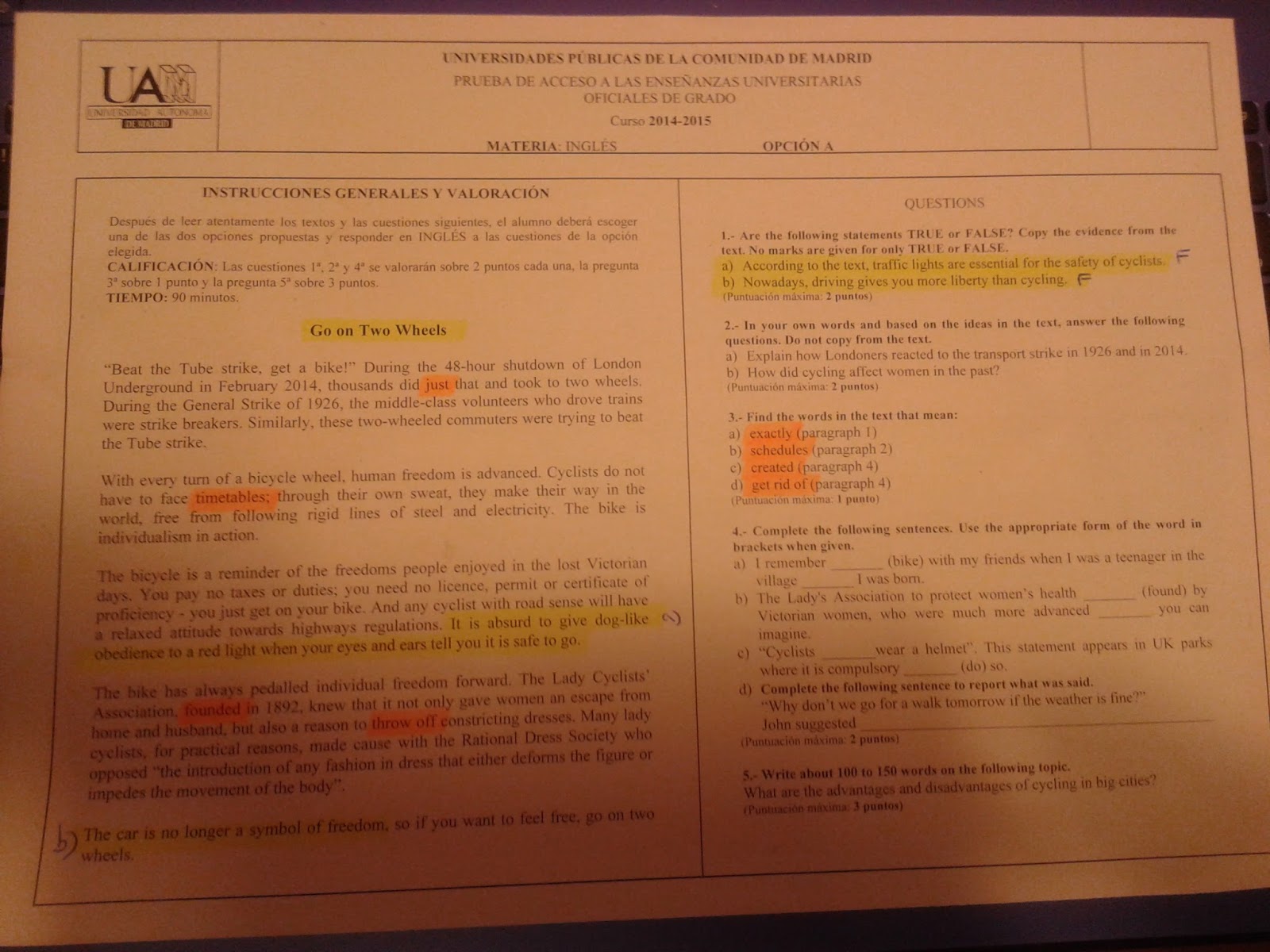
PAU SEPTEMBER 2015 A

GO ON TWO WHEELS


Exercise 4.

a) biking / where

b) was founded / than

c) Must / to do

d) John suggested going for a walk 
the following day
if the weather was fine.

for December the 28th, do B


Tuesday, December 13, 2016

PAU September 2016 B


Hello again, and welcome to our second PAU exam this year.

Did you find option B easier, more difficult or the same as 
option A?

I have added two words to be looked for in the text:

Find the verbs in the text that mean:

Be very good at (2nd paragraph), sobresalir.

Dismiss, not consider (2nd paragraph), dejar de lado.

(Definitions and translations taken from: www.wordreference.com)

They are underlined in red colour:


Exercise 4.

a) shown / produces

b) were encouraged / wouldn´t be 
(Conditional type 2)

c) more / at

d) The teacher told me 
not to worry at that moment 
since / because I would understand it
the following day.

Please, if you haven´t done it yet, order your packet of PAU exams at the Copier´s Room.

For next Wednesday, we´ll do Go on two wheels
(2014-2015, option A)

Thank you!


Wednesday, December 7, 2016

Our Library


This is the bookself where our English books are in our Library.
As you come into the library it´s on your right, next to the computers.
Most of them are graded and you can choose the one you consider the most suitable for your level of English.
Remember to bring your Student´s card to borrow the one/ones you prefer.
We have more books at the Department.
Come and borrow your book from the Department if you prefer to.

READ THE BOOK 
AND

Due to:

January


Pau September 2016 A

In red colour:
Phrasal verb: take off
Prepositional verbs

In green colour:
Connectors


In yellow colour:
The answers to question 1.
In pink colour:
The answers to question 3.


Question 4.

a) has become / most

TENSES (present perfect) / SUPERLATIVES

b) had worked / would have been been used

CONDITIONAL SENTENCES (third type, passive)

More about conditional sentences 1 & 2 here.
More about conditional sentences  type 3 here.

c) which / promoting.

 RELATIVE CLAUSES (non-defining) / verb + gerund.

More about relative clauses here.

d) Peter warned Sarah that her voice recognition system was not working at that moment.

REPORTED SPEECH. 

Examples of reported speech with warn here.

FOR NEXT WEDNESDAY: B
DON´T  FORGET YOUR COMPOSITIONS!

:-)


Monday, November 7, 2016

Hamlet


Hamlet is Shakespeare's longest play, and is ranked among the most powerful and influential tragedies in English literature, with a story capable of "seemingly endless retelling and adaptation by others". The play likely was one of Shakespeare's most popular works during his lifetime, and still ranks among his most performed, topping the performance list of the Royal Shakespeare Company and its predecessors in Stratford-upon-Avon since 1879. It has inspired many other writers. (wikipedia)


Summary:

(verbs in redconnectors in green)

Hamlet, the prince of Denmark, is a troubled young man. His father, the king. has been murdered, and his mother has married his father´s brother, Claudius, after only a few weeks.

One night, the ghost of the king appears to Hamlet and reveals that Claudius murdered him. He asks Hamlet to seek revenge, but Hamlet wants to find more proof of the murder first. To do this, he pretends to be driven mad by grief, and puts on a play for Claudius that tells the story of a murder similar to that of the king´s. It makes it very clear that the king has been murdered by his brother. When Claudius reacts nervously to the play, Hamlet is convinced he is guilty.

Hamlet goes to comfort his mother in her room, but he thinks he can hear Claudius hiding behind a curtain and stubs at him. Sadly, he has not killed Claudius. He has murdered Polonius, the father of Ophelia,a girl Hamlet once loved. The news drives Ophelia mad and she drowns herself.

These terrible events lead to more revenge and this time Polonius´son, Laertes (pronounced "Layer-tees), decides to punish Hamlet. Claudius sets up a duel between Hamlet and Laertes, but he gives Laertes a poisoned sword to make sure that Hamlet dies. Laertes fatally stabs Hamlet, but during the fight, the two men accidentally switch weapons and Hamlet also wounds Laertes with the poisoned sword.

A wounded Hamlet then manages to stab Claudius, but at that moment his mother drinks from the poisoned wine that Hamlet had prepared for Claudius. Laertes, Hamlet, his mother and Claudius all die --not really a happy ending.

 (from I wish I know that, Steve Martin, Mike Goldsmith, Marianne Taylor, Buster Books, 2010)


(Sparknotes)